
Table of Contents
ToggleVR gaming vs traditional gaming, it’s a debate that divides players and sparks strong opinions. Both offer distinct ways to experience interactive entertainment, but they differ significantly in how players engage with games. Virtual reality drops players inside digital worlds, while traditional gaming keeps the action on a screen. Each approach has clear advantages and drawbacks. This guide breaks down the key differences between VR gaming and traditional gaming. It covers immersion, cost, health effects, and game availability. By the end, readers will know which gaming style fits their preferences, budget, and lifestyle.
Key Takeaways
- VR gaming vs traditional gaming ultimately depends on your preferences, budget, and play style—neither format is universally superior.
- VR gaming delivers unmatched immersion by placing players inside digital worlds, while traditional gaming excels at longer sessions and complex genres like strategy and RPGs.
- Entry-level VR headsets start around $300, but traditional gaming offers more price flexibility with options ranging from $300 consoles to high-end PCs.
- Active VR games can burn 200-400 calories per session, making them a viable exercise option compared to sedentary traditional gaming.
- Traditional gaming boasts thousands of polished titles across major franchises, while VR libraries are smaller but growing with innovative experiences.
- VR requires dedicated play space and may cause motion sickness in about 40% of new users, whereas traditional gaming is more accessible for varied physical abilities.
Understanding the Core Differences
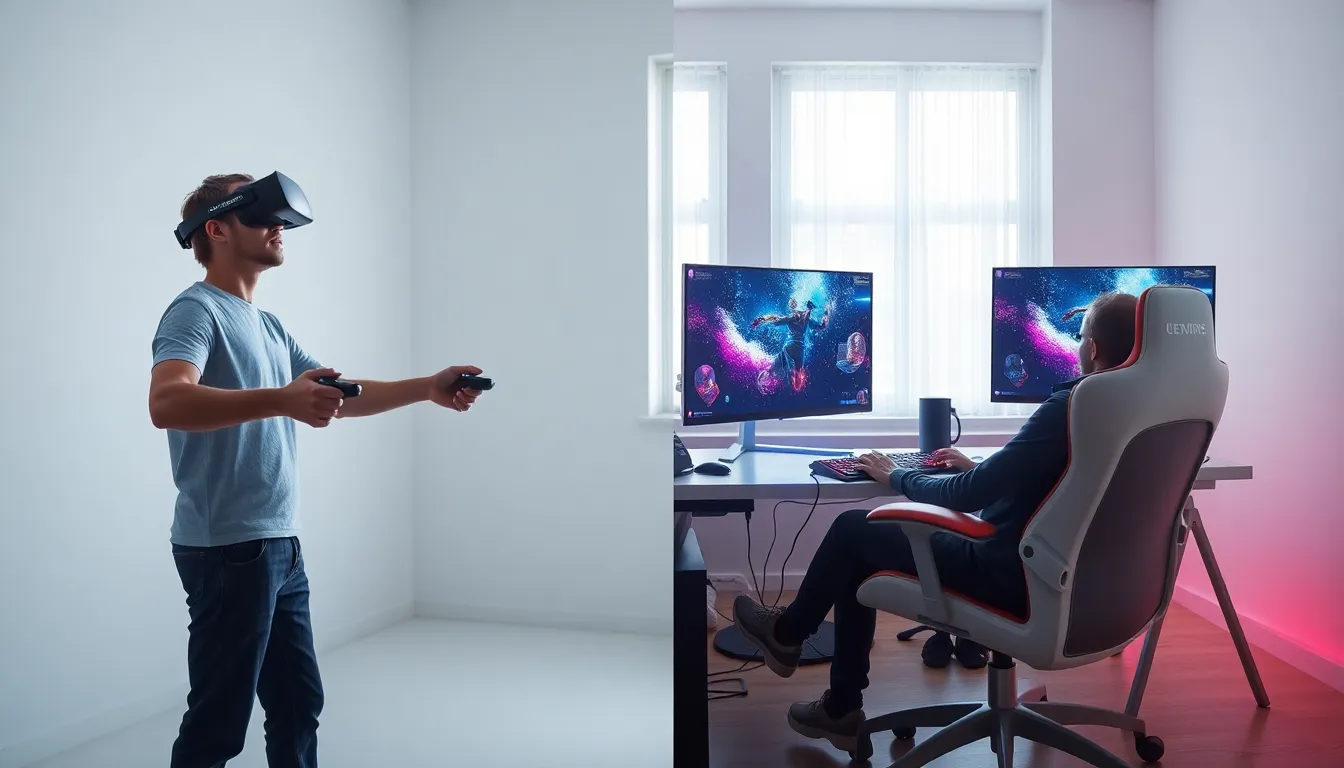
VR gaming vs traditional gaming comes down to how players interact with games. Traditional gaming uses a screen, controller, and sometimes a keyboard and mouse. Players sit in front of a TV or monitor and control characters from an external viewpoint. VR gaming puts the player inside the game. A headset covers the eyes and ears, creating a 360-degree environment. Motion controllers track hand movements. Some systems even track full-body motion.
The input methods differ too. Traditional games rely on button presses and joystick movements. VR games often require physical gestures, swinging a sword, pointing a gun, or reaching for objects. This fundamental difference shapes every aspect of the gaming experience.
VR gaming demands dedicated hardware. Players need a headset like the Meta Quest 3, PlayStation VR2, or a PC-connected device. Traditional gaming requires a console, PC, or handheld device. The technology behind each platform determines what kinds of experiences developers can create.
Immersion and Gameplay Experience
Immersion separates VR gaming from traditional gaming more than any other factor. VR creates presence, the feeling of actually being somewhere else. When a dragon flies overhead in VR, players instinctively duck. When standing on a virtual cliff, their palms sweat. Traditional gaming can’t replicate these visceral responses.
Traditional games offer their own strengths. They allow longer play sessions without fatigue. Strategy games, turn-based RPGs, and complex simulations work better on a flat screen. These genres require menu navigation, extensive reading, and prolonged focus. VR gaming vs traditional gaming isn’t about one being superior, it’s about matching the format to the content.
VR excels at first-person experiences. Horror games become genuinely terrifying. Rhythm games like Beat Saber turn music into a full-body workout. Exploration games let players examine objects up close, turning around virtual artifacts in their hands. Traditional gaming handles third-person perspectives, large-scale battles, and text-heavy narratives more smoothly.
Social gaming also differs between formats. VR chat rooms and multiplayer games create a sense of physical presence with other players. Traditional online gaming relies on voice chat and avatars that feel more distant. Both approaches build communities, but the social experience feels fundamentally different.
Cost and Accessibility Considerations
Cost creates a significant barrier when comparing VR gaming vs traditional gaming. Entry-level VR headsets start around $300 for standalone devices. High-end PC VR setups can exceed $1,500 when factoring in a capable computer. Traditional gaming offers more price flexibility, a Nintendo Switch costs $300, while a capable gaming PC ranges from $600 to $2,000.
Space requirements matter too. VR gaming needs room to move safely. Most VR systems recommend a minimum play area of 6.5 feet by 6.5 feet. Players must clear furniture and watch for pets or family members. Traditional gaming requires only a seat and a screen.
Accessibility presents challenges for VR. Motion sickness affects roughly 40% of new VR users to some degree. People with certain visual impairments or balance disorders may struggle with VR. Traditional gaming accommodates a wider range of physical abilities and includes more accessibility options.
The value proposition shifts based on usage. Someone who plays games for 30+ hours weekly might find traditional gaming more practical. A player seeking novel experiences for shorter sessions might prefer VR. Neither choice is wrong, the right answer depends on individual circumstances and priorities.
Health and Physical Impact
VR gaming vs traditional gaming affects the body differently. VR gaming can provide genuine exercise. Games like Supernatural and Beat Saber burn calories comparable to tennis or cycling. Thirty minutes of active VR gaming can torch 200-400 calories depending on the game and intensity.
Traditional gaming is largely sedentary. Extended sessions can contribute to issues like poor posture, eye strain, and repetitive stress injuries. That said, players can game traditionally for hours without physical exhaustion, a feature, not just a bug, for many gamers.
Eye health concerns exist for both platforms. Traditional gaming causes eye strain from extended screen viewing. VR headsets position screens inches from the eyes, raising questions about long-term effects. Current research hasn’t shown permanent damage, but optometrists recommend breaks every 20-30 minutes for either format.
Mental health effects vary. VR can provide powerful stress relief through immersive environments. It can also trigger anxiety in those sensitive to enclosed spaces or motion. Traditional gaming offers relaxation but lacks the escapist intensity VR provides. Both can become problematic with excessive use.
Game Library and Content Availability
Game selection heavily influences the VR gaming vs traditional gaming decision. Traditional gaming offers thousands of titles across decades of development. Major franchises like Call of Duty, FIFA, The Legend of Zelda, and Grand Theft Auto remain primarily traditional experiences. These games have massive budgets, long development cycles, and polished production values.
VR gaming libraries are growing but remain smaller. The Meta Quest store features around 500 titles. PC VR through Steam offers more options. Many VR games come from smaller studios with limited budgets. This isn’t necessarily negative, some of the most innovative gaming experiences exist in VR, but players expecting AAA polish across the board may feel disappointed.
Cross-platform availability is increasing. Some games offer both VR and traditional versions. Resident Evil Village, No Man’s Sky, and Microsoft Flight Simulator work in both formats. This trend may continue as VR adoption grows.
Content creation differs between platforms. VR development requires specialized knowledge about motion sickness prevention, physical interaction design, and performance optimization. These constraints limit what developers can create but also push creative boundaries in unexpected directions.


